Here are my much-belated post-ISIT notes. I didn’t do as good a job of taking notes this year, so my points may be a bit cursory. Also, the offer for guest posts is still open! On a related note the slides from the plenary lectures are now available on Dropbox, and are also linked to from the ISIT website.
From compression to compressed sensing
Shirin Jalali (New York University, USA); Arian Maleki (Rice University, USA)
The title says it, mostly. Both data compression and compressed sensing use special structure in the signal to achieve a reduction in storage, but while all signals can be compressed (in a sense), not all signals can be compressively sensed. Can one get a characterization (with an algorithm) that can take a lossy source code/compression method, and use it to recover a signal via compressed sensing? They propose an algorithm called compressible signal pursuit to do that. The full version of the paper is on ArXiV.
Dynamic Joint Source-Channel Coding with Feedback
Tara Javidi (UCSD, USA); Andrea Goldsmith (Stanford University, USA)
This is a JSSC problem with a Markov source, which can be used to model a large range of problems, including some sequential search and learning problems (hence the importance of feedback). The main idea is to map the problem in to a partially-observable Markov decision problem (POMDP) and exploit the structure of the resulting dynamic program. They get some structural properties of the solution (e.g. what are the sufficient statistics), but there are a lot of interesting further questions to investigate. I usually have a hard time seeing the difference between finite and infinite horizon formulations, but here the difference was somehow easier for me to understand — in the infinite horizon case, however, the solution is somewhat difficult to compute.
Unsupervised Learning and Universal Communication
Vinith Misra (Stanford University, USA); Tsachy Weissman (Stanford University, USA)
This paper was about universal decoding, sort of. THe idea is that the decoder doesn’t know the codebook but it knows the encoder is using a random block code. However, it doesn’t know the rate, even. The question is really what can one say in this setting? For example, symmetry dictates that the actual message label will be impossible to determine, so the error criterion has to be adjusted accordingly. The decoding strategy that they propose is a partition of the output space (or “clustering”) followed by a labeling. They claim this is a model for clustering through an information theoretic lens, but since the number of clusters is exponential in the dimension of the space, I think that it’s perhaps more of a special case of clustering. A key concept in their development is something they call the minimum partition information, which takes the place of the maximum mutual information (MMI) used in universal decoding (c.f. Csiszár and Körner).
On AVCs with Quadratic Constraints
Farzin Haddadpour (Sharif University of Technology, Iran); Mahdi Jafari Siavoshani (The Chinese University of Hong Kong, Hong Kong); Mayank Bakshi (The Chinese University of Hong Kong, Hong Kong); Sidharth Jaggi (Chinese University of Hong Kong, Hong Kong)
Of course I had to go to this paper, since it was on AVCs. The main result is that if one considers maximal error but allow the encoder only to randomize, then one can achieve the same rates over the Gaussian AVC as one can with average error and no randomization. That is, allowing encoder randomization can move from average error to max error. An analogous result for discrete channels is in a classic paper by Csiszár and Narayan, and this is the Gaussian analogue. The proof uses a similar quantization/epsilon-net plus union bound that I used in my first ISIT paper (also on Gaussian AVCs, and finally on ArXiV), but it seems that the amount of encoder randomization needed here is more than the amount of common randomness used in my paper.
Coding with Encoding Uncertainty
Jad Hachem (University of California, Los Angeles, USA); I-Hsiang Wang (EPFL, Switzerland); Christina Fragouli (EPFL, Switzerland); Suhas Diggavi (University of California Los Angeles, USA)
This paper was on graph-based codes where the encoder makes errors, but the channel is ideal and the decoder makes no errors. That is, given a generator matrix  for a code, the encoder wiring could be messed up and bits could be flipped or erased when parities are being computed. The resulting error model can’t just be folded into the channel. Furthermore, a small amount of error in the encoder (in just the right place) could be catastrophic. They focus just on edge erasures in this problem and derive a new distance metric between codewords that helps them characterize the maximum number of erasures that an encoder can tolerate. They also look at a random erasure model.
 coins with biases
 ![\{p_i : i \in [n]\}](https://s0.wp.com/latex.php?latex=%5C%7Bp_i+%3A+i+%5Cin+%5Bn%5D%5C%7D&bg=ffffff&fg=333333&s=0&c=20201002) . For some given
. For some given ![p \in [\epsilon,1-\epsilon]](https://s0.wp.com/latex.php?latex=p+%5Cin+%5B%5Cepsilon%2C1-%5Cepsilon%5D&bg=ffffff&fg=333333&s=0&c=20201002) and
and  , each coin is “heavy” (
 ) with probability
  and “light” (
 ) with probability
  . The goal is to use a sequential flipping strategy to find a heavy coin with probability at least
  .
. . On the basis of that, you need a rule to pick which coin to flip. Finally, you need a stopping criterion.
 heads and
  tails, then the likelihood ratio is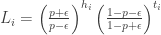
 so far (breaking ties arbitrarily).
 . These appear in the stopping criterion. The algorithm keeps flipping coins until there exists at least one $i$ for which
 heads and tails for a coin $i$,
 ,
,
 (plus lower-order terms), since that is the maximum possible expected hitting time for a random walk on an n-vertex graph [2]; the same bound applies to the random cop [4]. It is easy to see that the greedy cop who merely moves toward the drunk at every step can achieve
  ; in fact, we will show that the greedy cop cannot in general do better. Our smart cop, however, gets her man in expected time
  .
.
 -user interference channel with gains
  between transmitter
  . Then if


 -dimensional data points
 ![\{ \mathbf{x}_i : i \in [n] \}](https://s0.wp.com/latex.php?latex=%5C%7B+%5Cmathbf%7Bx%7D_i+%3A+i+%5Cin+%5Bn%5D+%5C%7D&bg=ffffff&fg=333333&s=0&c=20201002) the Lasso tries to fit the model
the Lasso tries to fit the model  by minimizing the
  penalized squared error
 .
. so the data is
 ![\{(\mathbf{X}_i, Y_i) : i \in [n] \}](https://s0.wp.com/latex.php?latex=%5C%7B%28%5Cmathbf%7BX%7D_i%2C+Y_i%29+%3A+i+%5Cin+%5Bn%5D+%5C%7D&bg=ffffff&fg=333333&s=0&c=20201002) . The assumptions are on the random variables
. The assumptions are on the random variables  is bounded, the variable
  , and
, and  , where
  and
and  are unknown constants. Basically that’s all that’s needed — given a bound on
  , he derives a bound on the mean-squared prediction error.
 , can be improved to
  . Most often this involves additional assumptions on the loss functions (which can sometimes get a bit baroque and hard to check). This paper considers constant step-size algorithms but where instead they consider the averaged iterate $\latex \bar{\theta}_n = \sum_{k=0}^{n-1} \theta_k$. I’m trying to slot this in with other things I know about stochastic optimization still, but it’s definitely worth a skim if you’re interested in the topic.
 be
be  in
in  . The convex hull
  of these points is called a Gaussian polytope. This is a random polytope of course, and we can ask various things about their shape : what is the distribution of the number of vertices, or the number of
  -faces? Let
  be the number of
  ) is given by
![\mathbb{E}[ f_k(P_n)] = \frac{2^d}{\sqrt{d}} \binom{d}{k+1} \beta_{k,d-1}(\pi \ln n)^{(d-1)/2} (1 + o(1))](https://s0.wp.com/latex.php?latex=%5Cmathbb%7BE%7D%5B+f_k%28P_n%29%5D+%3D+%5Cfrac%7B2%5Ed%7D%7B%5Csqrt%7Bd%7D%7D+%5Cbinom%7Bd%7D%7Bk%2B1%7D+%5Cbeta_%7Bk%2Cd-1%7D%28%5Cpi+%5Cln+n%29%5E%7B%28d-1%29%2F2%7D+%281+%2B+o%281%29%29&bg=ffffff&fg=333333&s=0&c=20201002) ,
, is the internal angle of a regular
  -simplex at one of its
  such that

 . That is, appropriately normalized, the number of faces converges to a constant.
 points to define a
  fraction of them will form a real
  , regardless of
 An Ergodic Walk