This is the second part in my blogging about some of the talks I saw at ITA 2008, and also a way for me to test a tag so that readers who don’t care about information theory won’t have a huge post hogging up their aggregator window (livejournal, I’m looking at you). Again, I may have misunderstood something in the talks, so if you see something that doesn’t sound right, let me know.
Monthly Archives: February 2008
the bad part of the evening
Dinner was great fun, but the part where it took me almost 3 hours to get home, 2.5 of which were spent stalled in traffic to get through the detour onto the bridge was not so fun. Ironically, I decided to drive because a late dinner in the outer Richmond would have possibly meant missing the last BART and having to take the transbay bus back, but given that I got home at 3, the bus would have been faster. Plus, I could have at least read something.
I don’t understand why they don’t post a sign when you go in to the city warning you that construction will be happening that night. Furthermore, it took the cops nearly 2 hours to get out onto the streets to regulate traffic. I overheard a cop talking to a construction guy, and it seems like the cops had no idea of the duration of the construction, which is mind-boggling. Why is this whole process riddled with incompetency? Had I known it what was going to happen, I would have just skipped the whole detour thing and gone down to San Mateo and back over. I would have gotten back in time that way.
Why oh why can’t we have better managed infrastructure upgrades?
a real reprint
My dissertation committee had to be reshuffled on short notice because my outside-the-department member became inside-the-department. Luckily for me, Prof. David Blackwell kindly agreed to serve on my committee. I had a meeting with him two weeks ago, wrote up a pseudo-précis of my dissertation, and had a short chat about it and Bayesianism today. Forty-eight years ago, he wrote the first paper on the arbitrarily varying channel [1], and today he gave me an actual reprint of the article!
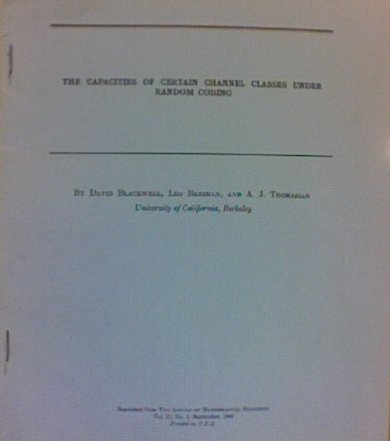
The staples are a little bit oxidized from time. I guess people couldn’t get rid of their reprints back then, even. QUESTA sent me reprints of my paper there and they’re just occupying space in my filing drawer. The worst part was, there was no option I could click for “no reprints — save the trees.” Of course, given my feelings about commercial publishing, I’m less likely to send a paper there in the future.
[1] D. Blackwell, L. Breiman, and A.J. Thomasian, The Capacities of Certain Channel Classes Under Random Coding, Annals of Mathematical statistics Stat. 31 (3), Sept. 1960, p.558-567.
musical epigraphs
In my ongoing quest to learn more about LaTeX than I really wanted to know, I have figured out how to use lilypond together with a redefined \chapter command. Of course, it’s all worth it because I can do this:

In other news, I’ll finish writing about ITA when I get more than 20 minutes of contiguous time.
Super Fat Tuesday
Happy Mardi Gras! And don’t forget to vote!
Africa? Where’s that?
The NY Times doesn’t bother having anything about the fighting in Chad on the front page (of the website). Instead, it has two articles about John McCain. Way go to, Gray Lady.
LaTeX instructions
To use 
$latex x = \frac{ - b \pm \sqrt{b^2 - 4 a c} }{2 a}
then you can close it with another dollar sign:
$.
Putting it all together, the renderer will give you:
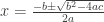
Basically, it’s like writing latex, except that every time you have to go into math mode, you have to type “latex” right after the first dollar sign.
pardon my dust
This blog is going down for a day or two (or perhaps the weekend) in order to move to a new home hosted by WordPress.com. They support LaTeX and I’ve decided to move the thing over there. It’ll take a few days for the domain redirection to catch up, so be forewarned.
The blog has now moved, and here is a test of the new embedded

Or

 An Ergodic Walk