Posting has been light

Due to extensive traveling around. At the end of August and beginning of September I attended a workshop at the American Institute of Mathematics on Permanents and modeling probability distributions. It was a lot of fun, and a lot different than any workshop I’d been to before. There were only 20 or so participants and every day we’d break out in smaller groups to actually work on some sub-problem or area. By the end of the week I felt like I’d had a crash course in large-alphabet probability estimation and also got a sense of the huge range of problems and techniques (from exchangeable random partition processes to Markov chain Monte Carlo) involved in tackling them.

Last week I gave a talk on gossip algorithms at UC Davis and got a chance to talk with a lot of people there. It was a great trip, except for the 6:30 flight time out of San Diego. Then last weekend there were heirloom tomatoes:

Heirloom Tomato with bread and Cowgirl Creamery Red Tail cheese

Heirloom Tomato with bread and Cowgirl Creamery Red Tail cheese


And also peach pie:
Peach pie...

Peach pie...


Mmmm, pie.

Dinner in Rio de Janeiro

I’ve had two good dinners already here (for those who are meat eaters). I should hit the gym to convert all the protein into muscle! The first was at Via Sete, which has pretty tasty appetizers, salads, and grilled meats and fish. We got some crab cakes (bolinhos) and calamari with manioc flour batter (it’s much soggy than normal fried calamari). I had a salad with grilled meat which was delicious (and also not too heavy, which was nice). The next dinner was at Braseiro de Gávea, a more traditional Brasilian restaurant. It was packed and the food was delicious — you basically order a set of grilled meat and it comes with one zillion side dishes (like farofa with eggs and banana, surprisingly delicious). I didn’t get to take pictures, but I might add them in later. Note : one dish serves about 3.5 people, so 3 dishes was waaaay too much food for the 7 of us. Afterwards we hit up the Academia de Cachaça, which was appropriate since some of us were in academia. They have a crazy array of cachaças to try in a pleasant open-air environment.

Pictures from Hong Kong, etc.

I have been castigated for not putting up more pictures of my trip to Hong Kong on Ye Olde Blog, so I’ll give a quick pointer to my Picasa album which has a lot of the pictures. So here is a somewhat backdated post on the trip.

On my first night there we went to Gaia Veggie Shop (大自然素食) in Mongkok for dinner. It’s an all-vegetarian place (with dishes containing egg marked on the menu). One of the dishes I liked best was a simple stir-fried pea shoots with ginger. I had forgotten how tasty pea shoots are, and the simplicity of the dish really brought out their flavor (this is the Cantonese style, I guess). The other option for dinner was Modern Toilet, a toilet-themed restaurant which may be worth a try later, although I was told the food wasn’t as good. I tried to take pictures of my restaurant adventures there (see the link). It’s spoiled me from eating Americanized Chinese food. Sidharth, my host, lives in a “market town,” which means he walks through a fresh produce market to get home every day. I got to try a lot of exciting fruits that are hard to get the US, including mangosteen, dragonfruit, lanzones, sitaphal (which I have only had in India, and is soooooo good), and even a durian shake (my second ever).

Being able to be in a place for more than one week was a real blessing, because I could go to some nieghborhoods more than once, and by the second week I would even leave without taking my guidebook or map with me, and just trust my memory and a hastily scribbled set of directions. Hong Kong is a pretty safe city, so wandering around and getting lost was a good and fun strategy. I’m sure people around me are sick of me talking about all the cool things I saw there, the quirky fun facts, and my love of the transit system there.

The coolest thing about transit in Hong Kong is the Octopus card, an transit card that works on all transit systems, various convenience stores (7-11 is everywhere there!), and even the CUHK cafeterias. You can add money to your card at 7-11, and there’s a deposit to get the card, so you can go to a negative balance (once) if you don’t have quite enough to get home. A close second is the red minibus system. These are 16-seater minibuses that run all night between different locations in Hong Kong. There are two that I used that went to CUHK, one from Mongkok and one from Causeway Bay. You pay something like 20 HKD and then once the bus is full it takes off at breakneck speed, only pulling over when someone calls out to the driver to stop. There’s a speedometer in the bus that starts beeping when the driver goes over 80 km/hr. Since I always took them late at night, the experience was a bit like being in a careening stick of dynamite. Exhilarating!

Oh, and we got some research ideas/projects started too.

sansai udon and variations

I made this recipe up after reading about udon dishes online and also consulting Harold McGee’s masterpiece On Food and Cooking, which had this great tidbit on katsuoboshi:

The most remarkable preserved fish is katsuoboshi, a cornerstone of Japanese cooking, which dates from around 1700, and is made most often from one fish, the skip-jack tuna Katsuwonus pelamis. The fish’s musculature is cut away from the body in several pieces, which are gently boiled in salt water for about an hour, and their skin removed. Next, they undergo a routing of daily hot-smoking above a hardwood fire until they have fully hardened. This stage lasts 10 to 20 days. Then the pieces are inoculated with one ore more of several different molds (species of Asptergillus, Euroticum, Penicillium, sealed in a box, and allowed to ferment on their surface for about two weeks. After a day or two of sun-drying, the mold is scraped off; this molding process is repeated three to four times. At the end, after a total of three to five months, the meat has turned light brown and dense; when struck, it’s said to sound like a resonant piece of wood.

Why go to all this trouble? Because it accumulates a spectrum of flavor molecules whose breadth is approached only in the finest cured meats and cheeses. From the fish muscle itself and its enzymes come lactic acid and savory amino acids, peptides, and nucleotides; from the smoking come pungent phenolic compounds; from the boiling, smoking, and sun-drying come the roasted, meaty aromas of nitrogen- and sulfur-containing carbon rings; and from the mold’s attack on fish fat come many flowery, fruity, green notes.

Katsuoboshi is to the Japanese tradition what concentrated veal stock is to the French: a convenient flavor base for many soups and sauces. It contributes its months of flavor-making in a matter of moments in the form of fine shavings. For the basic broth called dashi, cold water is brought just to the boil with a piece of kombu seaweed, which is then removed. The katsuoboshi shavings are added, the liquid again brought to the boil, and poured off the shavings the moment they absorb enough water to fall to the bottom. The broth’s delicate flavor is spoiled by prolonged steeping or pressing the shavings.

I found the ingredients at one of my many local Japanese markets, but they may be harder to find elsewhere. Sansai means “mountain vegetables” (edible bracken and other fun things) and is sold as a mix in the market. I made this twice in the last week, adding other ingredients that I had in the fridge. The first time I made it with enoki mushrooms and the white part of the scallions, and the second time with caramelized onions, oyster mushrooms, and some komatsuna that I got from Be Wise Ranch at the farmer’s market. I had never tried komatsuna before. It’s delicious!

Although the amazing kasuoboshi makes this non-vegetarian, I bet you can make a vegetarian version which will also taste good.

Sansai udon

Dashi:
6 cups water (ish)
1 4″ square piece of kombu (dried kelp)
1 5g packet of katsuoboshi (dried bonito shavings)

Tsuyu:
1/4 – 1/2 cup utsukuchi (light soy sauce) [less is more, often]
1-2 Tbsp mirin (sweet cooking sake)

Soup
cooked udon (thick Japanese noodles)
sansai (mountain vegetable mix)
sliced green onions for garnish
nori (dried seaweed) for garnish
whatever else you want to put into the soup

Rinse kombu and put in water and bring to just under boiling (I used a lower heat, medium-ish, to help the steeping). Remove kombu before boiling, then add katsuoboshi. Bring to just under boiling and then turn heat off. Let it sit until the katsuoboshi sinks. Strain out katsuoboshi. This is your (ichiban) dashi.

Heat dashi, soy sauce, and mirin to just before boiling. This is your tsuyu. Lower heat and add udon, then add sansai (they are generally pre-cooked). Heat for a little bit, then pour into a bowl and garnish. I would say this makes 3 servings of udon, but it depends on how you like your broth/stuff ratio.

Variants:

  • (with enoki and more green onions) Reserve white parts from the green onion garnish and chop finely. Heat some oil, add onions, cook until a little softer, then add enoki mushrooms and cook briefly. Add tsuyu and then proceed as above.
  • (with caramelized onions, oyster mushrooms, and komatsuna) Heat oil and caramelize sliced onions. Add mushrooms and cook until they start to give up their liquid, then add broth and cook noodles. As the noodles are finishing getting heated up, add the komatsuna and wilt, then remove from heat and serve.
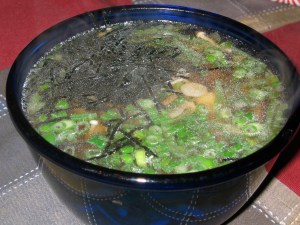
Sansai Udon with Enoki Mushrooms and Scallions
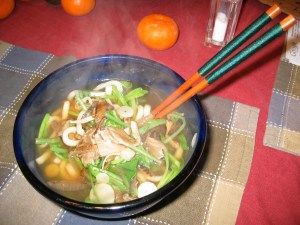
Sansai Udon with Enoki Mushrooms and Scallions

Sansai Udon with Oyster Mushrooms and Komatsuna

Sansai Udon with Oyster Mushrooms and Komatsuna

A much belated report on my trip to Baja California in early November

We drove from San Diego to Calexico, passing through some of southeast California’s deserts. In Calexico we had a classy meal at a Foster’s Freeze and purchased Mexican car insurance (a necessity for Americans driving over there, although we were never asked to prove that we had it). Another quirk of the law is that you have to bring the title for the car with you, which seems a bit risky. Going through the border to Mexicali was no problem, although getting out of Mexicali and on to the highway was too difficult for me, so Jen took over at that point and we coasted down the highway (which was in pretty good condition, despite what tour books suggested) to San Felipe. The drive was mostly uneventful, except for the obligatory stop and car-check by incredibly bored Mexican military dudes who are being paid by the US to look for drugs. Or at least that’s what I assumed they were doing.

Continue reading

Lal Bhaji

The Berkeley Bowl had red amaranth the other day, which is a vegetable my mother raves about, but was unavailable when I was growing up. In Chhattisgarh it’s called Lal Bhaji, and my mother told me to fry it up with onions, turmeric, mustard seeds, cumin, chilies, and tomato. The taste is similar to spinach, but a little less sweet — I like it better than the more bitter greens. The only downside is the time spent taking the leaves off.

At the Berkeley Bowl it’s called “Yin Choy,” and it’s with the little section of Chinese Vegetables I Know Very Little About And Learn About From Blogging. One of the Chinese students in the lab said to fry it up with a lot of garlic, which also sounds tasty.

Sangria Recipe

Here’s a new recipe for sangria that I’ve played around with. Basically you roast/cook the fruit first. In this version you can steam/poach the fruit in the OJ and liqueur. I think you can then get away with not adding any of the sugar that you find in other recipes. Actually, in that sense it’s not really a recipe, it’s more of a nod in the “try making it this way, it might work” direction. I like it, but I’m still twiddling around with how to do it right.

2 apples cut into 1/4″ pieces
3 small tangerines, sliced into rounds and then quartered
grapes, halved
other fruit if you feel like it

1 cup orange juice
1/3 c brandy
1/3 c triple sec or Cointreau

3 bottles of red wine

put cut fruit into roasting pan and add half of the orange juice, brandy, and triple sec. Cover in foil and bake at 300 for 20 minutes. Remove foil and broil for a few minutes if desired (this is a leftover from the old version where you don’t poach the fruit). Quench fruit with 1/2 bottle of wine. Mix remaining half of brandy, triple sec, and wine with fruit and chill for a few hours. Add a little sugar if you think it’s too tangy, but ideally you shouldn’t have to.