How do you attend conferences?

As I’ve gotten farther along in this whole research career, I’ve found it more and more difficult to figure out the optimal way to balance the different things one does at a conference :

  • Going to talks. This is ostensibly the point of the conference. It’s impossible to read all of the papers that are out there and a talk is a fast way to get the gist of a bunch of papers or learn about a new problem in less time than it takes to really read and digest the paper. We’re social creatures so it’s more natural to get information this way.
  • Meeting collaborators to talk about research problems. I have lots of collaborators who are outside TTI and a conference is a good chance to catch up with them face-to-face, actually sit down and hammer out some details of a problem, or work on a new problem with a (potential) new collaborator. Time sitting over a notepad is time not spent in talks, though.
  • Professional networking. I’m on the job market now, and it’s important to at least chat casually with people about your research, what you think is exciting your future plans, and the like. This is sometimes the “real” point of conferences.
  • Social networking. Sometimes conferences are the only times I get to see my friends from grad school, and in a sense your professional peers are the only people who “get” your crazy obsession with esoteric problem P and like to get a beer with you.

So the question for the readership : how do you decide the right balance for yourself? Do you go in with a plan to see at least N talks or a certain set S of talks, or are you open to just huddling in the corner with a notepad?

I wrote this post in an attempt to procrastinate about ITA blogging, which I will get to in a bit. I went to far fewer talks than I expected to this year, but I’ll write about ’em later.

Linkage (Chicago Edition)

The City of Chicago has a big open data initiative, and they are putting data online at the City of Chicago Data Portal. Lots of interesting stuff here, and some potential to get data sets for machine learning tasks.

A really touching video about Tamale Lady in Chicago.

The voices of the CTA. Reminds me a bit of the article on the Voice of the MBTA.

How to visit Chicago like a Chicagoan (h/t Mimosa) — warning, it’s pretty profane.

Ta-Nehisi Coates interviews Harold Pollack of the UChicago Crime Lab.

Postdoc opportunity at CSoI / Purdue

Postdoctoral Research Fellow ‐ Science of Information

Position Description: The Center for Science of Information (CSoI) invites nominations and applications for its CSoI Research Fellows program. The Fellows program seeks to identify and groom intellectual leaders to shape the emerging field of Science of Information and its diverse applications. The program provides opportunities for dynamic individuals to interact with premier research groups and individuals worldwide. Researchers in the Center for Science on Information have received the top awards in their fields (Rolf Nevanlinna Prize, Nobel Prize, Claude Shannon Award, and the Alan Turing Award). Research fellows will have opportunities to work in an enriching interdisciplinary environment, with significant potential for broad impact in terms of technology development, industry involvement, and educational initiatives. Successful candidates are expected to work with Center Researchers at two or more of the participating institutions. Fellows are appointed for an initial term of one year, and may be extended contingent on satisfactory performance.

Qualifications:

  • Candidate must have received a Ph.D. degree in a field related to the Science of Information within the past five years from an accredited college or university.
  • Candidates must have a track record of research contributions in information theory and/or associated areas related to the research agenda of the Center.
  • Excellent oral and written communication skills.

How to Apply: Applications should include:

  • A complete CV including education, employment history, and publications;
  • Statement of research interests, along with a short list of possible CSoI faculty they would be interested in working with; and
  • Names and contact information of at least three references

Please email nominations or applications to:
Search Committee Chair
CSoI Research Fellows Program
csoi@soihub.org

Applications will be accepted until Fellows have been selected. Review of applications will begin March 15, 2013.

About the Center for Science of Information:
CSoI is a NSF‐funded Science and Technology Center (STC) whose mission is to advance science and technology through a new quantitative understanding of the representation, communication, and processing of information in biological, physical, social, and engineered systems. The Center is a collaboration among computer scientists, mathematicians, engineers, biologists, and economists at several institutions including: Bryn Mawr, Howard, MIT, Princeton, Purdue, Stanford, Texas A&M, UC‐Berkeley, UC‐San Diego, and UIUC. Please visit the CSoI website for more information about the Center and current research activities.

The Center for Science of Information (CSoI) is committed to diversity and equality of opportunity. Applications from women, minorities, and persons with disabilities are encouraged.

My current job

I’ve had to do a lot of explaining about my current position and institution since moving here, especially when I go visit ECE departments. So I figured I might use the blog to give a quick rundown of the job. I’m a Research Assistant Professor at the Toyota Technological Institute at Chicago, a philanthropically endowed academic computer science institute located on the University of Chicago campus.

  • The Toyota Technological Institute at Chicago is a branch of the Toyota Technological Institute in Nagoya, Japan. Their website is a little slow to load, but the Wikipedia entry has more quick facts. TTI-Japan was founded through an endowment from the Toyota Motor Corporation in 1981 (so it’s younger than me). The Toyota Motor Corporation is not my employer, although some executives are on the board of the school.
  • I do not work for Toyota. My research has nothing to do with cars. At least not intentionally.
  • TTI-Chicago is basically a stand-alone computer science department and was started in 2003. It only has graduate students and grants its own degrees. It happens to be located on the University of Chicago campus — we rent two floors of a building which also contains the IT services. Classes at TTI are cross-listed with the University of Chicago — students at TTI take classes at UChicago and students at UChicago take classes at TTI.
  • I get an “affiliate” card for UChicago which lets me use the library and stuff. It’s great to have a library there, but since UChicago has no engineering, my access to IEEExplore is a bit limited.
  • The research at TTI-Chicago is mostly in machine learning, computer vision, speech processing, computational biology, and CS theory. This makes me a bit of an odd-one-out, but I have been doing more machine learning lately. It’s fun learning new perspectives on things and new problems.
  • The Research Assistant Professor position at TTI-Chicago is a 3-year position (some people have stayed for 4) which pays a 9 month salary (out of general institute funds) and gives a yearly budget for research expenses like travel/conferences and experimental costs (e.g. for Mechanical Turk or Amazon EC2). It’s not a “soft money” position but people are free to raise their summer salary through grants (like I did) or by taking a visiting position elsewhere for part of the year. I do not have to teach but can offer to teach classes or help teach classes
  • There are tenure-track faculty at TTI, and it’s the same tenure deal as elsewhere. Their teaching load is one quarter per year (that should make people jealous).
  • There are graduate students here, but not a whole lot of them. I can’t directly supervise graduate students but I can work with them on research projects. I’m starting to work with one student here and I’m pretty excited about our project.

A letter to EiCs about Manuscript Central

Dear Prof. Luo and Prof. Bölcskei —

I have been a reviewer for the IEEE Transactions on Signal Processing and the IEEE Transactions on Information Theory for the last few years, and I wanted to make a few requests regarding the configuration of Manuscript Central. I believe that these would make a small but significant improvement in the experience for reviewers.

  1. It is apparently possible to share login information across publications. Given the overlap between the research communities in SP and IT (and Communications) and the ubiquity of Manuscript Central as the management system, it seems that a common login would be very helpful.
  2. When reviewing, the phrase “For Peer Review Only” is emblazoned diagonally in light blue across each page of the PDF manuscript. Many reviewers I know have switched from printing out papers to reading them on their computer or tablet. The diagonal text interferes with text highlighting and other digital annotation features. I have been told that the “peer review notice” is optional. It would be great if it could appear somewhere less obtrusive — perhaps above the main text of the paper.

I know these seem like minor issues, but it seems that all that would be required to fix these is a request to Manuscript Central. Given the amount of money that the SP and IT societies are paying them, I am sure they would be happy to oblige.

(see this comment for why this should be easy).

The politics of your Butterworth filter order

Since I’ve diversified my research interests beyond communications, I kind of lost track of what has been happening in cognitive radio. Via Kevin Drum I learned of another proposed FCC auction of broadcast spectrum in the 600-700 MHz range. Apparently there’s a political debate over how wide the guard bands should be. On the one side, wide guard bands prevent more spectrum from being auctioned off, and on the other, they may allow for some municipalities to put in services operating in those bands (?)

I never thought I would see the day when the sharpness of your bandpass filter would become a political issue, but there you have it.

Readings

Baumgartner’s Bombay (Anita Desai) — I had heard about this book but never read it. A day in the life of Hugo Baumgartner, who as a teenager was sent as a refugee to India from Nazi Germany. He lives though the war (in an internment camp) and ends up decades later in a run-down flat surrounded by cats. It’s sad and fascinating.

The Light Fantastick (Terry Pratchett) — mind candy. It’s nice to read older Pratchett, which seems less lugubrious than the newer Pratchett.

Privacy (Garret Keizer) — a slim volume which ruminates widely on the notion of privacy. There’s a lot of research in here but it meanders a bit. I found it to be real food for thought and while I don’t always agree with him, the book is certainly a provocation to think and discuss. Recommended for people who like that sort of thing.

Fuzzy Nation (John Scalzi) — mind candy. Reminds me a bit of one of the Aspirin Phule novels.

The Jennifer Morgue (Charles Stross) — someone convinced me to take another chance on the Laundry novels. This one was better than the last one I thought, and held up rather nicely. I liked the Bond-esque ness of it. Recommended for people who like smart and snarky Cthulhu-like novels.

On entitlement and the Mystery Hunt

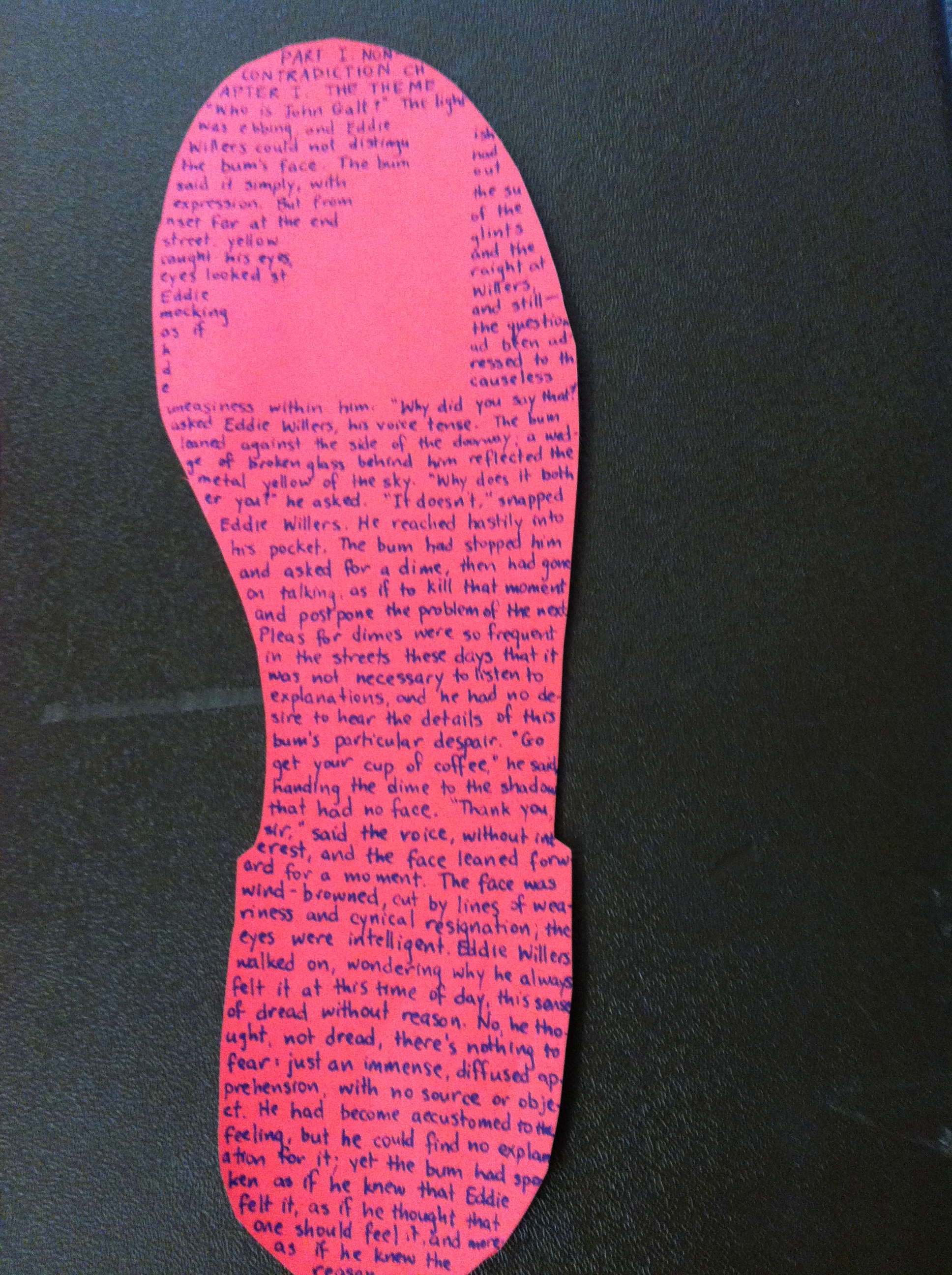
The MIT Mystery Hunt ended a little over a week ago — the premise is that a coin is hidden somewhere on campus and teams have to solve a bunch of puzzles to find its location. The prize for winning is writing it the next year. It was the longest hunt on record — 75 hours and 18 minutes if you count from the kickoff event, and 73 if you count from when the servers went live. My team, whose name is the entire text of the book Atlas Shrugged (although we often used the shorter name PART I: NON-CONTRADICTION; CHAPTER I: THE THEME ‘Who is John Galt?’…), managed to emerge victorious. Here’s a footprint outline we were given as part of an event puzzle:

Our team name on a footprint

Our team name on a footprint


And here are some fuzzy snaps of the coin:
The coin, obverse

The coin, obverse


The coin, reverse.  Now we can raise the debt ceiling.

The coin, reverse. Now we can raise the debt ceiling.

The hunt was so long because many of the puzzles were underclued and the team running it, Manic Sages, essentially mis-estimated how hard the Hunt would be (from gameplay and actual puzzles). Naturally there was much wailing and gnashing of teeth on the internet after this, and a lot of people took the Sages to task. Some of this criticism was a bit unfair, I think. The Sages put on a huge event for more than a thousand people, and much of it was quite fun. There were problems, sure, but let’s not get hyperbolic here.

Of course, hyperbole is par for the course, and Wired ran this piece by Thomas Synder who indulges in some pretty questionable plot extrapolation to conclude that there is a “trajectory” towards longer and longer hunts. For reference, here are the solving times for hunts up to 2010, showing the mysterious trend Snyder flags is more or less fabricated. So basically that line of argument is just hand-wringing. But why the calls for smelling salts?

The crucial line is this : “[w]hat started as an MIT-only event has now become a mainstay on the puzzle calendar.” Puzzle writers and solvers such as Snyder think that MIT Mystery Hunt puzzles should be less… well, MIT. One of the metapuzzles required you to know something about Feynman diagrams. There was a fractal word search. This is not a complaint about puzzles having too many steps, but about them being too nerdy or too inaccessible to those who have a “puzzle calendar.” Of course, those sorts of things are right up the alley of some MIT students. The subtext of this article is that it’s just not “professional” enough.

The Hunt is a free event (for solvers) that costs several thousands of dollars to put on, is much longer than most other puzzle events, and is done entirely by volunteers. In the case of Sages (and my team), many or most of those people are students. The sense of entitlement voiced by Snyder in this article (and by others elsewhere) is palpable. The fact that it’s a mainstay of the “puzzle calendar” is irrelevant — the Mystery Hunt owes its participants a good time, and those participants are still largely drawn from the MIT community, I think. Sure there were moments when I was not having fun, but also moments when I was having a lot of fun solving. There were some great/innovative puzzles in this hunt, and other great/innovative puzzle ideas. I wouldn’t keep going to Mystery Hunt if it was going to be like any other puzzle contest, and this hunt definitely delivered, even if reading some of the solutions breaks my brain.

Just next year, we’ll try to make it shorter, of course.

NIPS casinos flooded

I had a rather dim view of the NIPS conference venue last year — the Harrah’s and Harveys casino/hotels in South Lake Tahoe. Nothing is more depressing than people playing the slots at 8 AM, smoking and drinking away. Via Erin, I learned that the casinos flooded and are closed : “thousands of gallons of water dumped into Harrah’s, causing the elevators to break.” I can only hope that this is somehow an excuse to not hold NIPS there in the future — but I’m not holding my breath (which I did to avoid the smoke).