Allerton 2010 : the sessions’ (lack of) timing

Warning: small rant below. I’m probably not as ticked off as this makes me sound.

One thing that seemed significantly off this year from previous times I’ve been to Allerton is that around 3/4 of the talks I attended went over the alloted time. Why does this happen?

For one thing, more than half of the sessions at Allerton are invited. This means that some speakers know what they are going to talk about in general, but haven’t necessarily pinned down the whole story. This is amplified by the fact that the camera-ready paper is due on the last day of the conference (the deadline was pushed back to Monday this year). For invited talks, many people have not even started writing the paper until they get on the plane, adding uncertainty as to what they can or should present. Little lemmas are proved hours before the deadline. It’s not unusual to make slides on the plane to the conference, but if the actual results are in flux, what are you going to put on the slides? Why, the entire kitchen sink, of course!

The actual session brings up other issues. Because people are editing their slides until the last minute, they insist on using their own laptop, causing delays as the laptops are switched, the correct display is found, and the presentation remote is set up. This is a gigantic waste of time. Almost all laptops provided by conference organizers are PCs, which can display PDF (generated by LaTeX or Keynote) and PowerPoint. Why must you use your own laptop? So the slide transitions will be oh-so pretty?

Finally, many session chairs don’t give warnings early enough and don’t enforce time constraints. Once a habit of talks running over is established, it becomes unfair to cut off one speaker if you didn’t cut off another. Naturally, speakers feel upset if someone got more time to present than they did.

What we should ask ourselves is this : is the talk for the benefit of the speaker or for the benefit of the audience?
assorted links and news

More on self-plagiarizing.

This looks like an interersting book on the homeless, especially given all the time I spent in the Bay Area.

Tyler Perry has shortened the title of his film adaptation of Ntozake Shange’s For Colored Girls Who Have Considered Suicide When the Rainbow is Enuf.

Evaluating Fredric Jameson.

Max really digs in to directed information.

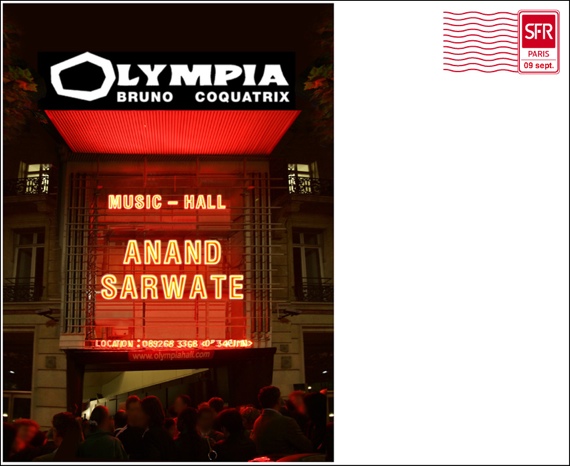
In other news, after ITW I went to Paris to hang out and work with Michele Wigger on a small story related to the multiaccess channel with user cooperation. While I was there saw some fun art by Detanico/Lain and caught a show by Fever Ray at L’Olympia. In fact, I’ll be headlining there soon:

ADS Headlines at L'Olympia

Have a good Sunday, everyone!

Postdocs at UC have unionized

By now it’s officially official, but postdoc employees across the UC system unionized and got a contract with the university. Here are a few of the good things that came out:

  • experience-based minimum salary steps according to the NIH/NRSA pay scale – these are minimum pay guidelines, so PIs who feel generous can of course pay more. Why are minimum pay requirements important? Many postdocs are here for 5 years. With durations like that, the position is not “training,” it’s a job. And therefore we should treat it like a job. Prior to this contract, many postdocs were receiving well below the minimum that NIH recommends, even though they were funded by NIH grants. In addition, you cannot be a postdoc for more than 5 years — after that you should be hired as a staff scientist. Some PIs oppose this, because postdocs are “cheaper” than staff scientists.
  • health insurance – the UC administration wanted to slash benefits in a way that would ultimately end up cutting compensation.
  • workplace safety – suppose the lab you work in is unsafe, but if you report any violations your PI may fire you. Does that seem fair?

There are a lot of other things in there, especially with regards to time off, parental leave, and so on. There is a pernicious attitude in the sciences that if you have kids while a grad student/postdoc/pre-tenure faculty you are “not serious about your career.” If you have 6 years of grad school and then 5 years of postdoc and then start a tenure-track job, and wait to have kids until after tenure, you might be 38 or 40. Breaking this attitude is hard, but it’s really starts with establishing basic expectations and treating employees like people.

And that is why this contract is important. I think of it as a restructuring of the playing field — without rules from the University as a whole, PIs are incentivized to pay postdocs as little as possible and work them as hard as possible, trading on the reputation of their lab and the University to make the deal more palatable. This is not to say most PIs do this, but certainly some do. With this contract there is a minimum set of rules by which PIs have to play, rules which are in fact in accordance with recommendations by funding agencies.

In talking about this with faculty from different places, I’ve heard diverse perspectives on why this is a difficult thing for them to accept, the fears they have about being demonized or not being able to have the flexibility they feel is so important to being able to run the kind of research program that they desire. These are important concerns, and ones which can and should be explored as this new contract is implemented. However, I have heard no good proposals from them about how to address the real issues faced by postdoctoral employees, whereas this contract does just that.

UC Libraries vs. the Nature Publishing Group

Earlier this month, a letter was circulated to the UC Faculty regarding the Nature Publishing Group (NPG)’s proposal to increase the licensing fees for online access by 400%, which is pretty dramatic given a) the high cost of the subscription in the first place and b) the fact that library budgets are going down. There was a suggestion of a boycott.

NPG felt like they had been misrepresented, and issued a press statement saying “you guys are a bunch of whiners, our stuff is the best, and 7% price hikes per year is totally reasonable.” Furthermore, they said “you guys have been getting a crazy good deal for way too long anyhow and its time you paid your fair share.” I suppose behaving like complete jerks is an ok way to react when you are trying to sell somebody something, especially something that is made up of stuff written by your potential buyers. I wonder what their profit margins are like.

The University of California responded, pointing out that 7% increases, compounded, starts getting out of hand pretty fast. “Plainly put, UC Faculty do not
think that their libraries should have to pay exorbitant and unreasonable fees to get access to their own work.”

Looks like PLoS better start rolling out some new titles!

More info can be found at the OSC website, which oddly doesn’t say what OSC stands for.

Talk at USC Wednesday

In case you’re at USC or in the area, I’m giving a talk tomorrow there on some of the work I’ve been doing with Kamalika Chaudhuri (whose website seems to have moved) and Claire Monteleoni on privacy-preserving machine learning.

Learning from sensitive data – balancing accuracy and privacy

Wednesday, March 24th, 2010
2:00pm-3:00pm
EEB 248

The advent of electronic databases has made it possible to perform data mining and statistical analyses of populations with applications from public health to infrastructure planning. However, the analysis of individuals’ data, even for aggregate statistics, raises questions of privacy which in turn require formal mathematical analysis. A recent measure called differential privacy provides a rigorous statistical privacy guarantee to every individual in the database. We develop privacy-preserving support vector machines (SVMs) that give an improved tradeoff between misclassification error and the privacy level. Our techniques are an application of a more general method for ensuring privacy in convex optimization problems.

Joint work with Kamalika Chaudhuri (UCSD) and Claire Monteleoni (Columbia)

What’s the point of an X department?

Over at Crooked Timber there’s a discussion on eliminating some majors to save money, particularly if they don’t have many graduates.

The issue made it to Leiter because several of the Philosophy departments in those institutions fall into the low-major category. But is producing Philosophy majors the point of having a Philosophy department? In Our Underachieving Colleges (CT review still on its way: DD to blame if I never get round to it) Derek Bok claims that the standard assumptions within most departments in research universities is that the undergraduate curriculum is for attracting and then teaching majors, and, further, that our attention to the majors should be shaped by the aim of preparing them well for graduate school. This means that the curriculum is designed for a tiny minority of the students who take classes, and even many of them, probably, would be better off doing something other than going to graduate school (that’s me, not Bok, saying the last bit).

Philosophy departments should take heed of Samidh’s observation that philosophers are good entrepreneurs and point out that they may produce the next big alumni donor!

I wonder the degree to which Bok’s claim is true in mathematics, science, and engineering. I think it’s probably true that the average biology major or electrical engineer is being prepared for work at a company. Even senior electives are useful in this sense, especially if they are project-oriented. However, it’s probably the case that if you major in math and do not plan to go to graduate school, then your senior seminar in commutative algebra is pretty much useless for the work you’ll do later. But is the average math major at a public university being prepared for (some) graduate program? Is math in this sense closer to the humanities programs mentioned above?

In electrical engineering, it’s to go work in a company (or for the government) designing/building stuff, and those specialized classes are geared for that. On average, I think undergraduate programs in engineering in the US don’t emphasize going on to graduate study. An exception is the profit-turning one-year masters programs that have become popular in recent years. Designing a program to prepare people primarily for graduate school or designing a program to prepare people primarily for the workforce misses the point of college.

The story you hear is that a classical liberal arts education in the US is supposed to teach you to think critically and be an active and thoughtful member of society. So what does that mean for engineers? In a sense, design choices are a form of critical analysis within the context of engineering, but I think that kind of perspective can be construed more broadly. We’re so keen on formulating notions of optimality or engineering tradeoffs that we don’t also consider the societal aspects of the things that we design. It would be nice to get upper-division engineering classes that talk about where technology is headed, where society is headed, and how those interact on a more technical level. This kind of thinking is good preparation for work and for research. I think there are some classes like that out there, but they’re more or an anomaly than the norm, and they’re not really required. But it would be valuable for the students, regardless of where they go.

Papers : you know, to organize ’em

I ponied up the money and bought Papers recently — it’s not perfect but it does let me store all of those pesky PDFs I have lying around in a convenient single location.

The program acts like “iTunes for your papers.” It has its own internal storage system (which is also customizable) and lets you create collections (e.g. playlists). The best feature is the interface to various repositories such as PubMed, ArXiV, JSTOR, ACM, and Web of Science. It technically lets you search IEEEXplore as well, but IEEE just upgraded their system (color me unimpressed), which broke the current version of Papers’ search interface. I’m sure it will get fixed soon enough.

What I wish it let you do was to tag papers so that you can click on a tag to see all papers tagged with that topic; while this functionality is there, it’s not transparent to do it. I’d also like it if the BibTeX was associated as metadata with the paper file, so that I could integrate it better with BibDesk. I had contemplated getting DEVONthink to organize all of my files, but I felt like that was overkill.

Does anyone else out there have a killer system for organizing papers? I know it’s just a crazy dream that I’ll actually get a chance to read most of the papers I have sitting on my hard drive, but I’ll be more likely to read ’em if I can find ’em.

Pitfalls in author ordering

Apparently the number of co-authored papers in political science is on the rise, and there are questions on how to order the author names. I had never heard the phrase “the tyranny of the alphabet” before to refer to alphabetical author ordering, but I know that since conventions are different in math/statistics, computer science, and electrical engineering, there ends up being a lot of confusion (esp. on the part of graduate students) as to who actually did “most of the work” on a paper. Fan Chung Graham gives a succinct description of an ideal:

In math, we use the Hardy-Littlewood rule. That is, authors are alphabetically ordered and everyone gets an equal share of credit. The one who has worked the most has learned the most and is therefore in the best position to write more papers on the topic.

This ideal doesn’t really hold in electrical engineering (or computer science, for that matter), and can lead to some dangerous assumptions when people’s conventions vary or when you are doing interdisciplinary work.

Continue reading

Privacy Workshop at IPAM

I’m at the Institute for Pure and Applied Math at a workshop on Statistical and Learning-Theoretic Challenges in Data Privacy. It’s a rather diverse group of computer scientists, statisticians, medical informatics, and policy researchers, and I feel a bit like I’m the only electrical engineer here. It’sa been pretty educational in the “learning about new problems” way, but I think by the time Friday morning rolls around I’ll be suffering from information overload. The nice thing is that the slides are posted online so I can refresh my memory when I get back. There’s also a poster session for some more recent results.

Most of the speakers have been talking about either (a) applications of the differential privacy model to some problems (e.g. data release, function computation, classification, PAC-learning, auctions, or Google’s MapReduce, the Census Bureau’s OnTheMap, and PINQ)or (b) areas in which privacy is a real problem (hospital discharge data and the dangers of re-identification, genome-wide association studies (GWAS), query logs from search engines, or (c) bridges between fields and their privacy definitions and models.

I’ve just started working in this area, so I’m still processing things (the talks range from high level to technical, and I often lack the background to understand fully what’s going on). I might blog a bit more about it as things come up.