Bach Collegium San Diego Bach Motets Recording

I know I don’t blog so much these days (lots of traveling), but I wanted to advertise a bit for album on which I sang.

Bach Collegium San Diego : Six Motets

J.S. Bach: The Six Motets BWV 225-230

Bach Collegium San Diego is proud to announce its first recording available for commercial release. Artistic director Ruben Valenzuela leads a nimble yet expressive ensemble of 19 musicians: 16 singers with continuo.

Singet dem Herrn ein neues Lied BWV 225
Der Geist hilft unser Schwachheit auf BWV 226
Jesu, meine Freude BWV 227
Fürchte dich nicht, ich bin bei dir BWV 228
Komm, Jesu, komm!, BWV 229
Lobet den Herrn, alle Heiden BWV 230

Order it

assorted links and news

More on self-plagiarizing.

This looks like an interersting book on the homeless, especially given all the time I spent in the Bay Area.

Tyler Perry has shortened the title of his film adaptation of Ntozake Shange’s For Colored Girls Who Have Considered Suicide When the Rainbow is Enuf.

Evaluating Fredric Jameson.

Max really digs in to directed information.

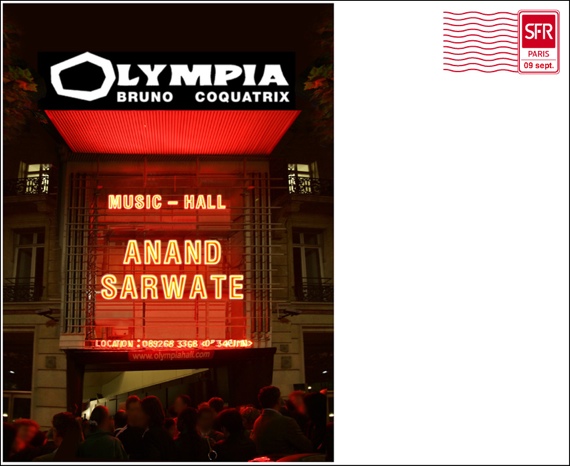
In other news, after ITW I went to Paris to hang out and work with Michele Wigger on a small story related to the multiaccess channel with user cooperation. While I was there saw some fun art by Detanico/Lain and caught a show by Fever Ray at L’Olympia. In fact, I’ll be headlining there soon:

ADS Headlines at L'Olympia

Have a good Sunday, everyone!

some slightly more recent reads

Suspended in Language (Jim Ottaviani and Leland Purvis) — a graphic novel about Niels Bohr, his life, his theories, and the birth of modern physics. This was a great read and wonderful introduction for those with a scientific bent but perhaps less physics background (me in a nutshell).

Logicomix(Apostolos Doxiadis and Christos Papadimitriou) — continuing with the intellectual comic book trend, this was a semi-fictionalized history of the foundations of mathematics from the perspective of Bertrand Russell. There’s a lot going on in the book, which tries to examine the connections between logic and madness, maps versus reality, and Russell versus Wittgenstein. I very much enjoyed the beginning of the book but it sort of rushed into the ending : I wanted more about Gödel!

Botany of Desire (Michael Pollan) — this is a lyrically written book about the relationship between people and plants. Pollan goes through 4 case studies : the apple, the tulip, marijuana, and the potato, and describes how the plants satisfy human desires and how humans have shaped the course of their evolution. The writing in this book is beautiful, but his favorite words seem to be Apollonian, Dionysian, and chthonic, which lends some of the text an almost 19th century feeling. His dissection of the issues with GMO farming and Monsanto in the potato chapter is great, but I wish it was more accessible to the average reader. Ah well, it’s a book for elites, and a very pretty book at that.

Interracial Intimacy: The Regulation of Race and Romance (Rachel F. Moran) — This was a slightly more legalistic and policy-oriented analysis of how interracial relationships were regulated by the state in the United States. Unlike Kennedy’s book, it has a fair bit more about non black-white relationships, and highlights the differences faced by different ethnic groups. Also unlike Kennedy’s book, it is not aggressively arguing an a particular agenda. Kennedy was building up an argument against race-matching in adoption, and Moran is a little more circumspect and seems (at least to my mind) to be more attuned to the dangers of being prescriptivist. It’s definitely a dry read, but I found it quite informative.

ITW Dublin : historical take on polar codes

I am at ITW in Dublin, and I will write a short post or two about it. I missed most of the conference until now due to jetlag and late arrival, but I did make it to Arikan’s plenary lecture this morning on the historical context for polar codes. It was a really nice talk about successive decoding and how it relates to polar codes. A central issue is the computation cutoff rate R_{comp}, which prevents successive decoding from reaching capacity.

He described Pinsker’s “concatenated” construction of convolutional encoders around a block code, which is capacity-achieving but inefficient, and Massey’s 1981 construction of codes for the quaternary erasure channel which decomposes the QEC into two parallel BECs whose noise is correlated (you just relabel the 4 inputs with 2 bits and treat the two bits as going through parallel BECs). This is efficient, increases R_{comp}, but is not enough to get to capacity. However, in a sense, Massey’s construction is like doing one step in polar codes, and combining this with Pinkser’s ideas starts getting the flavor of the channel polarization effect.

Good stuff!

Completely ridiculous stock photography

I get the IEEE Communications and Signal Processing magazines electronically to save paper (I find they don’t make for great bus reading, so the print version is less appealing). Every month they dutifully send me an email with possibly the most ridiculous stock images. For example, here’s the one for the Signal Processing magazine:

Happy Signal Processing Dude

Oh man, I am so STOKED to get this Signal Processing Magazine! Wooo hoooo!

First off, who is this dude, and what is wrong with his life such that getting this magazine makes him so happy? Clearly he’s not an engineer since he’s wearing a suit. Maybe he works in finance? Of perhaps government, since he’s walking down some pretty “city hall”-looking stairs. Maybe it’s a courthouse, and he’s been cleared of all charges, thanks to the evidence in the signal processing magazine?

Now here’s the Communications one:

Peek inside Communications

Hey there, want to have some sitcom-like hijinks with 4G communication systems?

Again, who is this woman, and why is she creepily hiding behind the magazine, only to pop around the side, holding the pages shut just as I’m opening it? You scared me, lady! What are you trying to do, give me a heart attack? Or are you some sort of not-so-subtle ploy to lure the predominantly male engineering audience to download the magazine?

Honestly, I wish IEEE would not bother paying for the graphic design of the download image and instead use the money for something else, like defraying subscription costs for developing nations. As it stands, these emails make me take the magazine less seriously.

an old-ish thought

I just got another email about a “Frontiers in X” conference, so I thought of this. Have you ever noticed how biology and medicine always have conferences that have the word “frontiers” in the title? I guess that’s because they are very high dimensional phenomena, and as we know, the sphere in high dimensions has all of its mass at the boundary.

Of course, the downside is that the volume of the unit sphere goes to 0 as the dimension goes to infinity…

Lossless compression via the memoizer

Via Andrew Gelman comes a link to deplump, a new compression tool. It runs the data through a predictive model (like most lossless compressors), but:

Deplump compression technology is built on a probabilistic discrete sequence predictor called the sequence memoizer. The sequence memoizer has been demonstrated to be a very good predictor for discrete sequences. The advantage deplump demonstrates in comparison to other general purpose lossless compressors is largely attributable to the better guesses made by the sequence memoizer.

The paper on the sequence memoizer (by Wood et al.) appeared at ICML 2009, with follow-ups at DCC and ICML 2010 It uses as its probabilistic model a version of the Pitman-Yor process, which is a generalization of the “Chinese restaurant”/”stick-breaking” process. Philosophically, the idea seems to be this : since we don’t know the order of the Markov process which best models the data, we will let the model order be “infinite” using the Pitman-Yor process and just infer the right parameters, hopefully avoiding overfitting while being efficient. The key challenge is that since the process can have infinite memory, the encoding seems to get hairy, which is why “memoization” becomes important. It seems that the particular parameterization of the PY process is important to reduce the number of parameters, but I didn’t have time to look at the paper in that much detail. Besides, I’m not as much of a source coding guy!

I tried it out on Leo Breiman’s paper Statistical Modeling: The Two Cultures. Measured in bytes:

307458 Breiman01StatModel.pdf         original
271279 Breiman01StatModel.pdf.bz2     bZip (Burrows-Wheeler transform)
269646 Breiman01StatModel.pdf.gz      gzip
269943 Breiman01StatModel.pdf.zip     zip
266310 Breiman01StatModel.pdf.dpl     deplump

As promised, it is better than the alternatives, (but not by much for this example).

What is interesting is that they don’t seem to cite much from the information theory literature. I’m not sure if this is a case of two communities working on related problems and unaware of the connections or that the problems are secretly not related, or that information theorists mostly “gave up” on this problem (I doubt this, but like I said, I’m not a source coding guy…)