Allerton 2010 : the sessions’ (lack of) timing

Warning: small rant below. I’m probably not as ticked off as this makes me sound.

One thing that seemed significantly off this year from previous times I’ve been to Allerton is that around 3/4 of the talks I attended went over the alloted time. Why does this happen?

For one thing, more than half of the sessions at Allerton are invited. This means that some speakers know what they are going to talk about in general, but haven’t necessarily pinned down the whole story. This is amplified by the fact that the camera-ready paper is due on the last day of the conference (the deadline was pushed back to Monday this year). For invited talks, many people have not even started writing the paper until they get on the plane, adding uncertainty as to what they can or should present. Little lemmas are proved hours before the deadline. It’s not unusual to make slides on the plane to the conference, but if the actual results are in flux, what are you going to put on the slides? Why, the entire kitchen sink, of course!

The actual session brings up other issues. Because people are editing their slides until the last minute, they insist on using their own laptop, causing delays as the laptops are switched, the correct display is found, and the presentation remote is set up. This is a gigantic waste of time. Almost all laptops provided by conference organizers are PCs, which can display PDF (generated by LaTeX or Keynote) and PowerPoint. Why must you use your own laptop? So the slide transitions will be oh-so pretty?

Finally, many session chairs don’t give warnings early enough and don’t enforce time constraints. Once a habit of talks running over is established, it becomes unfair to cut off one speaker if you didn’t cut off another. Naturally, speakers feel upset if someone got more time to present than they did.

What we should ask ourselves is this : is the talk for the benefit of the speaker or for the benefit of the audience?

PSA for Allerton authors who use TeXShop

The papercept website will throw an error if your final PDF is lower than version 1.4. If you use latex -> dvips -> ps2pdf then you will likely get PDF 1.3.

To fix this in TeXShop, go to Preferences and select Engine. Under “Tex + dvips + distiller” enter simpdftex tex --maxpfb --distiller ps2pdf14 and you should be good to go.

More posting about Allerton later!

ITW 2010 : finishing up

Blogging conferences seems to have gone by the wayside for me, but some quick takes on things from ITW. It was a more coding-focused conference so there were fewer talks of active research interest to me, but I did get to catch up and talk shop with a few people, so that was nice.

Tali Kaufman (who seems to have no homepage) gave a plenary on “Local computation in codes” which looked at fast (sublinear time) algorithms for detecting if a binary vector is from a code, and fast ways to correct single bit errors. In particular, she was looking at these properties in the context of LDPC codes. It’s a nice place where information theory and CS theory look at the same object but with different intents.

Ueli Maurer gave a great talk on “A Cryptographic Theory of System Indistinguishability,” which started out kind of slow and then ended up at a breakneck speed. This was a way of thinking about crypto from the perspective of systems being able to simulate each other.

Rudolf Ahlswede talked a bit about strong converses and weak converses for channels with a rather generic “time structure.” Essentially this boils down to a difference between lim inf and lim sup, and he gave a rather short proof showing that capacities exist under very mild conditions and that the additivity of capacity (e.g. for two parallel channels) may hold in some settings but not others.

There were lots of other good talks that I enjoyed but I didn’t take particularly good notes this time (I blame the jet lag), so I don’t have much to say here. Tomorrow is the start of Allerton, so I might take better notes for that.

Information Theoretic Anagrams

I have been visiting Berkeley for the end of last week and beginning of this week, and part of my job was to clean out this old box of papers and printouts that I left when I moved down to UCSD. Most of the papers I printed out in grad school didn’t make it down, and a small fraction of those I ended up re-printing at ITA. It’s a sad waste of paper, but I also noticed that I printed out lots of them because someone said to check them out and I did print-first-read-second. Thankfully as time wore on I have switched to the other direction, but I don’t know if I’ll ever be able to do the all-electronic e-reader thing. I just love marking up papers with a red/green/purple pen. Some of the more heavily marked ones are coming back with me. Hopefully they won’t weigh down the plane too much.

One of the little gems I found among the photocopies of old reimbursement forms, conference schedules, and mouldering reprints of my optical queueing article was Bob McEliece‘s handout from his 2004 Shannon Lecture on “Some Information-Theoretic Anagrams”:

  • A Sound Channel
  • Brainy Coed
  • Rome Noodles
  • Cubed Roots
  • UCLA Shenanigans
  • Coordinate Spasm
  • Momentary Mixup
  • Acquiescent Yelp

Bach Collegium San Diego Bach Motets Recording

I know I don’t blog so much these days (lots of traveling), but I wanted to advertise a bit for album on which I sang.

Bach Collegium San Diego : Six Motets

J.S. Bach: The Six Motets BWV 225-230

Bach Collegium San Diego is proud to announce its first recording available for commercial release. Artistic director Ruben Valenzuela leads a nimble yet expressive ensemble of 19 musicians: 16 singers with continuo.

Singet dem Herrn ein neues Lied BWV 225
Der Geist hilft unser Schwachheit auf BWV 226
Jesu, meine Freude BWV 227
Fürchte dich nicht, ich bin bei dir BWV 228
Komm, Jesu, komm!, BWV 229
Lobet den Herrn, alle Heiden BWV 230

Order it

assorted links and news

More on self-plagiarizing.

This looks like an interersting book on the homeless, especially given all the time I spent in the Bay Area.

Tyler Perry has shortened the title of his film adaptation of Ntozake Shange’s For Colored Girls Who Have Considered Suicide When the Rainbow is Enuf.

Evaluating Fredric Jameson.

Max really digs in to directed information.

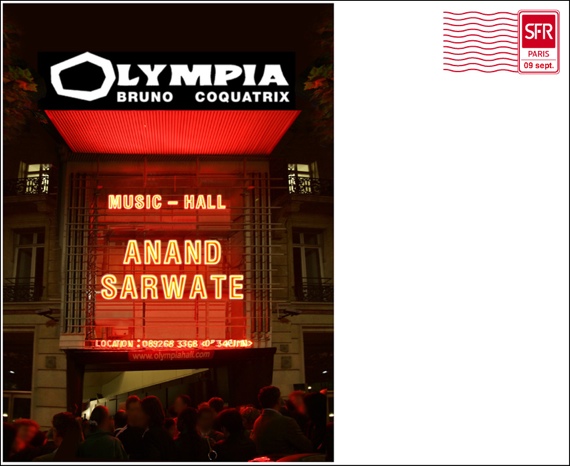
In other news, after ITW I went to Paris to hang out and work with Michele Wigger on a small story related to the multiaccess channel with user cooperation. While I was there saw some fun art by Detanico/Lain and caught a show by Fever Ray at L’Olympia. In fact, I’ll be headlining there soon:

ADS Headlines at L'Olympia

Have a good Sunday, everyone!

some slightly more recent reads

Suspended in Language (Jim Ottaviani and Leland Purvis) — a graphic novel about Niels Bohr, his life, his theories, and the birth of modern physics. This was a great read and wonderful introduction for those with a scientific bent but perhaps less physics background (me in a nutshell).

Logicomix(Apostolos Doxiadis and Christos Papadimitriou) — continuing with the intellectual comic book trend, this was a semi-fictionalized history of the foundations of mathematics from the perspective of Bertrand Russell. There’s a lot going on in the book, which tries to examine the connections between logic and madness, maps versus reality, and Russell versus Wittgenstein. I very much enjoyed the beginning of the book but it sort of rushed into the ending : I wanted more about Gödel!

Botany of Desire (Michael Pollan) — this is a lyrically written book about the relationship between people and plants. Pollan goes through 4 case studies : the apple, the tulip, marijuana, and the potato, and describes how the plants satisfy human desires and how humans have shaped the course of their evolution. The writing in this book is beautiful, but his favorite words seem to be Apollonian, Dionysian, and chthonic, which lends some of the text an almost 19th century feeling. His dissection of the issues with GMO farming and Monsanto in the potato chapter is great, but I wish it was more accessible to the average reader. Ah well, it’s a book for elites, and a very pretty book at that.

Interracial Intimacy: The Regulation of Race and Romance (Rachel F. Moran) — This was a slightly more legalistic and policy-oriented analysis of how interracial relationships were regulated by the state in the United States. Unlike Kennedy’s book, it has a fair bit more about non black-white relationships, and highlights the differences faced by different ethnic groups. Also unlike Kennedy’s book, it is not aggressively arguing an a particular agenda. Kennedy was building up an argument against race-matching in adoption, and Moran is a little more circumspect and seems (at least to my mind) to be more attuned to the dangers of being prescriptivist. It’s definitely a dry read, but I found it quite informative.